

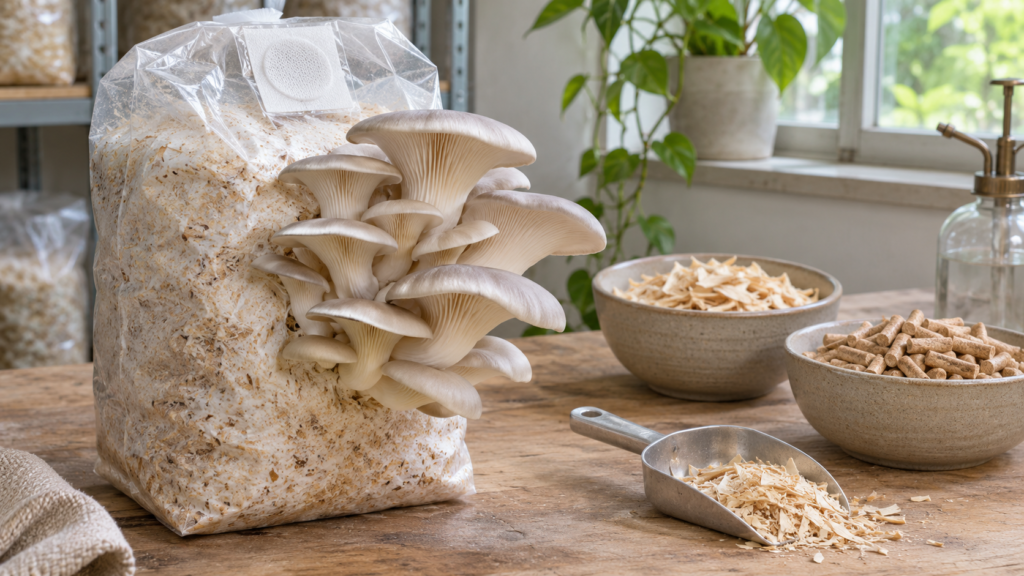
Oyster mushrooms are among the most adaptable cultivated fungi, but “hardwood substrate” is not a single recipe. Tree species, particle size, moisture, supplements and preparation all affect how a block behaves. The most useful answer to “which hardwood mix is best?” is to choose a consistent, species-appropriate base and test one change at a time.
Does oyster mushroom need hardwood?
For Pleurotus ostreatus, hardwood sawdust is a common wood-based option. Oyster mushrooms can also grow on suitable plant materials such as straw and other agricultural residues, so hardwood is not the only route. Match the substrate to the oyster species and strain you are growing, and follow the spawn or kit supplier’s directions.
If your goal is a hardwood block, start with clean, untreated sawdust or shavings from a known hardwood source. Avoid painted, treated or engineered wood. Keep the wood source consistent between batches; “mixed hardwood” can vary from supplier to supplier, which makes results harder to compare.
Why texture and water matter
A substrate needs to hold moisture while leaving enough air space for mycelium. Very fine material can pack tightly; very coarse pieces may leave large gaps and make a block uneven. A blend of particle sizes can help, but there is no universal ratio that suits every species, bag and preparation method.
Moisture is just as important. A mix that is too dry can slow colonization, while excess water can reduce air space and create conditions where unwanted microbes compete. Use a preparation method and hydration target that are tested for your chosen substrate and equipment. Do not assume that a dry weight recipe automatically works when the source material or particle size changes.
Should you add a supplement?
Wheat bran, soy hulls and other nutrient-rich materials are used in some mushroom substrate formulations. They can change the nutrient balance, but adding more is not automatically better: richer mixtures need careful preparation and may be less forgiving of contamination. For a first hardwood grow, it can be easier to begin with a supplier-tested formula or a simple, consistent base before experimenting with supplements.
Research helps explain why one “best mix” is hard to name. A 2026 white-oyster trial compared several combinations of sawdust, corn cobs and rice husks; the best-performing treatment in that experiment was 30% sawdust, 40% corn cobs and 30% rice husks. That result describes the tested strain and conditions, not a universal hardwood formula. A separate 2026 study measured the chemical properties of oak and birch sawdust and other residues as potential substrate ingredients. It was a preliminary materials assessment, not a fruiting-yield test. Taken together, the studies are a reason to compare complete recipes rather than select a wood by name alone.
A practical way to choose
- Pick the mushroom first. Use a substrate intended for your oyster species or the one recommended with your spawn.
- Choose a traceable base. For a wood-based block, use clean hardwood material with no coatings or preservatives, and record its source.
- Keep your first batch simple. Use one known recipe and preparation method. Change only one factor, such as the hardwood source or supplement, in a later batch.
- Keep notes. Record the ingredient proportions, moisture, preparation, inoculation date and colonization progress. Compare like with like instead of relying on memory.
Where spawn and bags fit
Substrate is the material the mycelium will colonize; spawn is the living inoculum added to it. The shop’s Oyster Mushroom mycelium on grains is a ready-made grain spawn option for growing on a suitable substrate. If you are preparing a bagged block, the filter bags with an inoculation port are listed for mushroom growing and include a port for inoculation. Check the product instructions and your own equipment requirements before choosing a bag.
For reliable first results, use a substrate recipe matched to your culture, prepare it consistently and resist changing several ingredients at once. The “best” hardwood mix is the one that performs reliably with your mushroom strain and process. If you compare recipes, label each bag and keep an unchanged reference batch. Record the wood source and preparation details so a better result can be repeated, and a poorer result can be traced to a specific change.
Sources: Arip et al. (2026), substrate compositions for white oyster mushrooms; Szymańska et al. (2026), physicochemical assessment of substrate materials for Pleurotus ostreatus.