

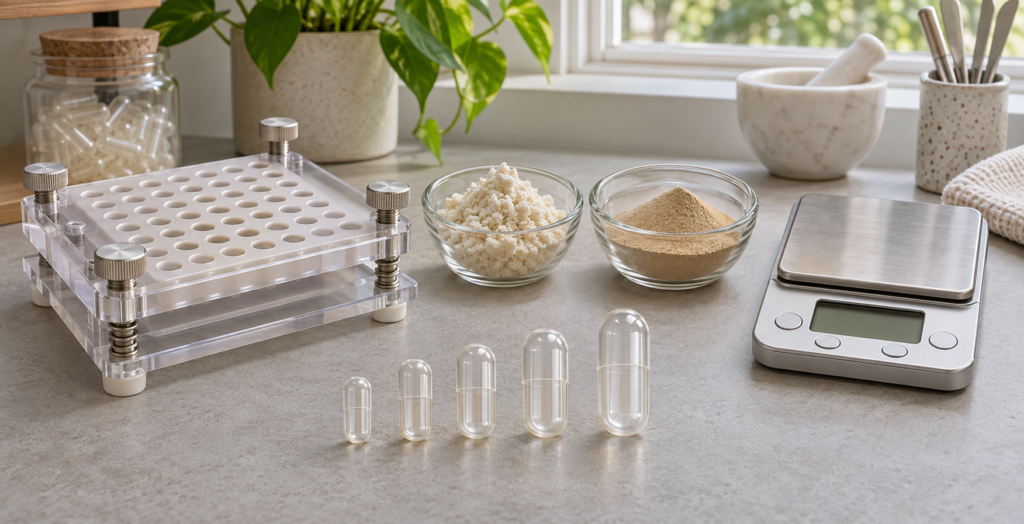
“Size 0” and “size 00” tell you about a capsule’s dimensions and internal volume; they do not promise a fixed powder weight. A light, fluffy blend and a dense powder can occupy the same shell while weighing very different amounts. That is why powder density matters when choosing a size or filling machine.
Capsule size is volume, not milligrams
Capsule numbering runs in reverse: 000 is larger than 00, which is larger than 0, then 1 and smaller sizes. The numbers are a size series, not a fill-weight scale. As one supplier’s chart illustrates, a size 0 capsule has about 0.68 mL of internal volume and size 00 about 0.91 mL. Values can vary slightly by manufacturer and capsule design, so use the specification for the shell you actually buy.
The shop currently lists vegetarian and vegan capsules in sizes 1, 0 and 00 and gelatin capsules in sizes 0, 00 and 000. Those ranges give you shell options; they do not determine how many milligrams a particular powder will weigh in each shell.
What powder density changes
Density is the mass of powder occupying a given volume. If a powder is loose and airy, a capsule body may hold fewer grams than it holds of a fine, dense powder. A simple estimate is:
estimated powder mass = capsule volume × powder density
For example, at an illustrative density of 0.5 g/mL, a 0.68 mL size 0 shell would hold about 0.34 g (340 mg) by this calculation. At the same density, a 0.91 mL size 00 shell would hold about 0.46 g (460 mg). These are volume-based estimates, not guaranteed fill weights. The powder’s particle size, blend, moisture and how it settles can change the result.
Filling method matters too
Powder may be measured loosely poured, after tapping to settle, or after being pressed during filling. A hand plate, repeated tamping and a powered production filler do not necessarily pack the same blend to the same density. A general chart can help you shortlist a size, but it cannot tell you the exact fill your powder and machine will achieve. Capsule manufacturer Capsules.com explains that density and filling method affect estimated weight and recommends confirming the result on the actual machine.
This is also why a size chart should not be treated as a recipe. If you change the powder blend, grind, or tamping routine, recheck the fill. Keep the process consistent when you compare batches.
A practical way to choose
- Start with the shell specification. Check the capsule maker’s listed internal volume and size range, not just a generic “mg per capsule” chart.
- Use your finished blend. If you measure density, use the same powder blend and the same settling method you plan to use for filling.
- Make a small trial batch. Fill a few shells with your intended machine and technique. Weigh a sample on a suitable scale and check that the halves close cleanly.
- Match the filler to the shell. The shop’s manual capsule filling machines are available for size 0 or 00, and each machine fits only its specified capsule size. Choose the shell first, then the matching machine.
- Record the result. Note the powder blend, capsule size, filling method and observed weight range. Repeat the check after any meaningful change.
An empty shell’s own weight is also separate from the powder capacity. Shell materials or suppliers can differ in empty-shell weight while the useful internal volume stays close, so compare the maker’s volume data and weigh the filled result rather than guessing from how heavy an empty capsule feels.
Batch capacity is another separate choice. A 400-hole plate can arrange more capsules per run than a 100-hole plate, but the hole count does not change the size or automatically verify each fill. Select a machine whose size matches the shell, then decide how many capsules you want to handle in one batch.
Common sizing mistakes
- Assuming a capsule’s size number means a fixed milligram capacity.
- Using a density estimate for a different powder or a different settling method.
- Choosing a filling machine by batch capacity while overlooking its capsule-size setting.
- Filling to a generic chart’s maximum without checking whether your own blend closes consistently.
For consumer-scale experiments, a supplier chart and a small trial can help you choose a practical shell. For products with strict formulation or fill-weight requirements, use validated specifications and appropriate quality controls instead of relying on an online estimate.
Technical references: Capsules.com’s capsule size and internal-volume chart; Capsules.com’s guide to density, tamping and fill weight.