

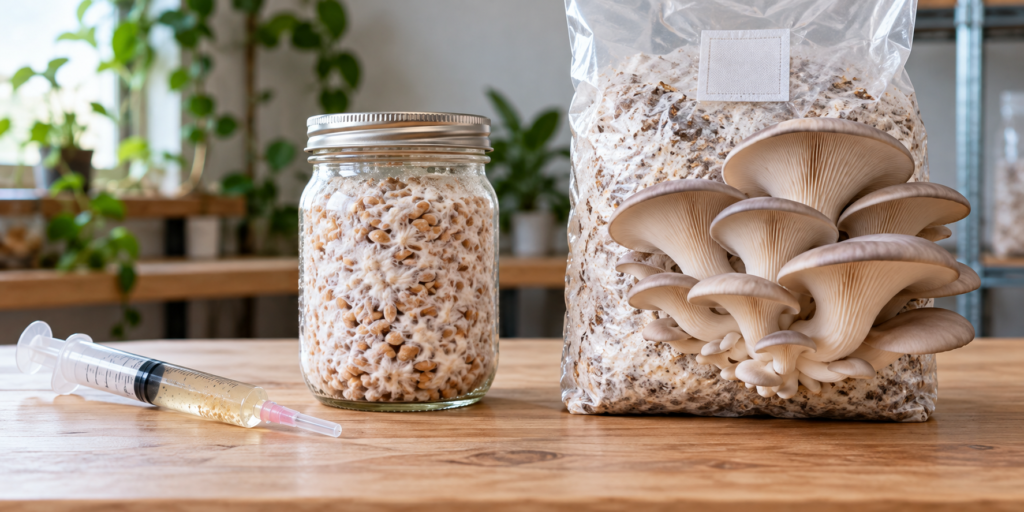
When you are starting a mushroom grow, three terms can sound interchangeable: liquid culture, grain spawn and substrate. They describe different materials and different jobs. Knowing where each fits helps you choose a starting point, avoid unnecessary steps and spot problems earlier.
The simple sequence
A common indoor workflow is clean culture → grain spawn → fruiting substrate → mushrooms. Liquid culture is one way to start or expand mycelium. Grain spawn is a colonized carrier that distributes mycelium through a larger growing material. The substrate is the material the mushroom colonizes and, in many systems, fruits from. This is a useful model, not a rule for every species or product: follow the supplier’s instructions for the particular culture and growing system.
What is liquid culture?
Liquid culture (often shortened to LC) is living mushroom mycelium suspended in a sterile nutrient liquid. It is supplied in a syringe or jar so a small amount can be transferred into a suitable sterile medium. Think of it as a starter culture, not as finished spawn and not as a ready-to-fruit mushroom block.
Its practical advantage is easy transfer into clean grain or another specified medium. It is compact to store and can be useful when you want to start several batches. Its main drawback is that contamination can be difficult to judge by appearance alone: cloudy liquid or unusual growth may be a warning, but clear liquid does not prove a culture is clean. Work aseptically and use the product according to its instructions.
For example, the shop’s Lion’s Mane liquid mycelium syringe is described for transfer to sterile grain or sawdust. That wording matters: the syringe is an inoculum for the next step, rather than a substitute for prepared spawn.
What is grain spawn?
Grain spawn is grain already colonized by mushroom mycelium. The grain kernels act as many small points of growth when mixed through a larger substrate. Penn State Extension describes spawn production as sterilizing grain, then adding mycelium and allowing it to grow; Cornell Cooperative Extension defines spawn as mycelium together with a carrier material used to inoculate a crop.
For a home grower, ready-made grain spawn skips the culture-to-grain expansion stage. It is generally the step used to inoculate a prepared fruiting substrate. Check the listing carefully: “mycelium on grains” is spawn, while a liquid syringe is a culture intended to start growth on a medium. The shop’s Shiitake mycelium on grains is an example of grain spawn.
What is substrate?
Substrate is the prepared growing material that supplies structure, moisture and nutrients for the chosen mushroom. Depending on species and method, it may be straw, hardwood sawdust, compost or another suitable material. It is not automatically sterile or ready to inoculate; preparation depends on the material and the grower’s process.
Some growers mix grain spawn into a bulk substrate; others use a substrate block or bag prepared for a particular culture. A filter patch bag can help contain a prepared growing medium while allowing gas exchange, but a bag by itself is not spawn or substrate. See the shop’s filter bags with an inoculation port for one equipment option.
Which one should you choose?
- Choose liquid culture when you want a starter for sterile grain or another medium specified by the supplier, and you are comfortable working cleanly.
- Choose grain spawn when you want to inoculate a prepared substrate without first expanding a liquid culture.
- Choose a substrate or grow kit when you want to begin closer to the fruiting stage; check whether it is already inoculated or still needs spawn.
For a first project, fewer transfers usually mean fewer opportunities for contamination and fewer unfamiliar steps. Start with a species-appropriate product, read its storage and use directions, and keep notes on what you inoculated, when, and how the culture changed.
Quick comparison
| Material | What it contains | Main role |
|---|---|---|
| Liquid culture | Mycelium in nutrient liquid | Starter culture for a suitable medium |
| Grain spawn | Mycelium colonizing grain | Distribute mycelium into substrate |
| Substrate | Prepared growing material | Support colonization and mushroom growth |
For more background, see the Utah State University Extension beginner’s guide, Cornell Cooperative Extension’s mushroom terminology, and Penn State Extension’s overview of mushroom production and spawn.