

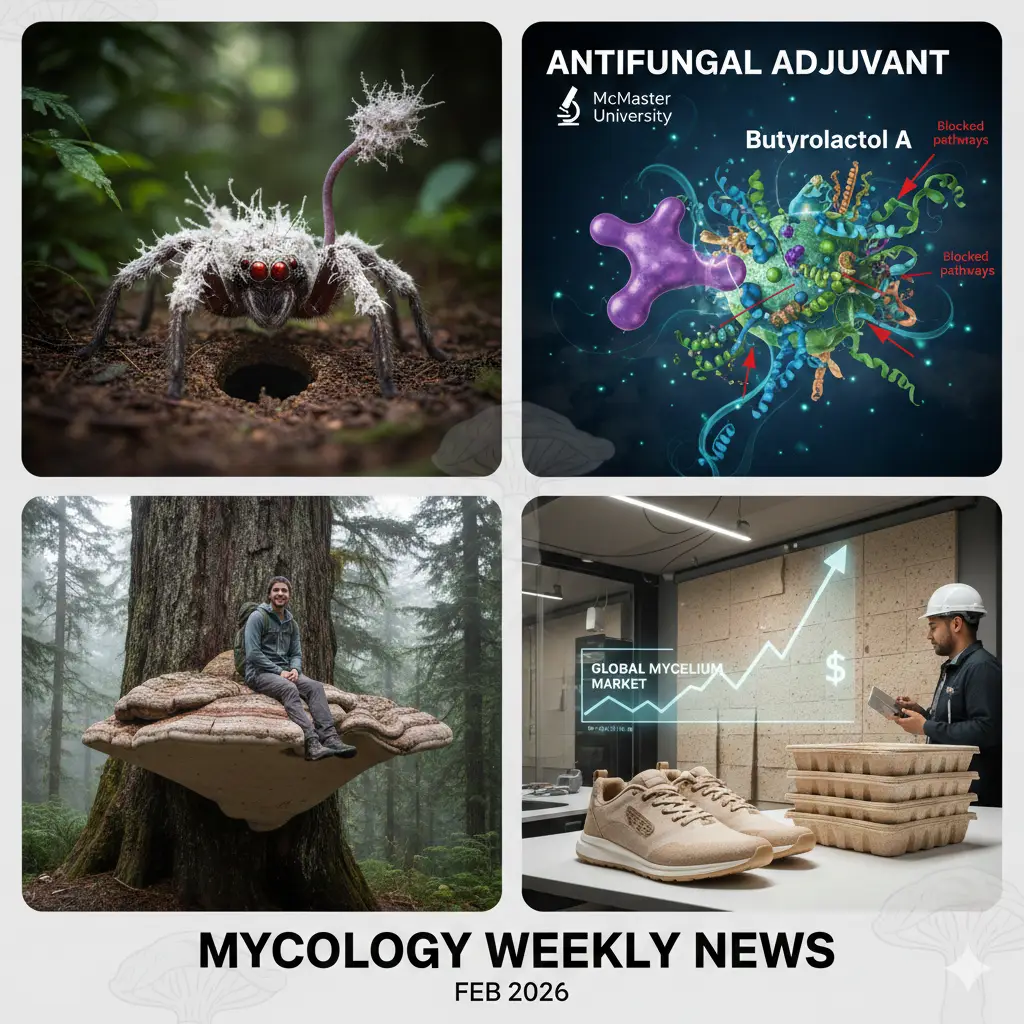
The fungal kingdom continues to surprise us this February, with researchers uncovering everything from parasitic “zombie” fungi in the Brazilian rainforest to revolutionary medical breakthroughs that could save millions of lives. Here are the top four stories that defined the mycological landscape over the last seven days.
1. The “Zombie” Fungus of Brazil
Scientists at the Royal Botanic Gardens, Kew, have officially named Purpureocillium atlanticum, a parasitic fungus discovered in Brazil’s Atlantic Forest. This specialized predator infects trapdoor spiders within their own burrows. Once the fungus takes hold, it consumes the spider from the inside out, eventually sending a 2-cm fruiting body through the spider’s trapdoor to release its spores. This discovery highlights the intricate and often brutal specialized roles fungi play in maintaining forest ecosystems.
2. A New Weakness in Deadly Fungi
In a major health breakthrough, researchers at McMaster University have identified a molecule called butyrolactol A that could be a game-changer in the fight against drug-resistant fungal infections. Instead of killing fungi directly, this molecule acts as an “adjuvant”—it sabotages the internal defense systems of dangerous pathogens like Cryptococcus neoformans. This allows existing antifungal drugs, which were previously useless due to resistance, to become effective once again. This discovery could revive an entire class of medicines and provide a new lifeline for immunocompromised patients.
3. The Colossal “Seat” Mushroom of India
A “colossal” new species of macro fungi, Bridgeoporus kanadii, has been identified in the West Kameng district of India. Found growing on old-growth fir trees, this fungus is noted for its massive, leathery, and incredibly sturdy fruiting bodies. Lead researchers remarkably noted that the mushroom is so strong it can support the weight of a person sitting on it while remaining firmly attached to the tree. This find underscores the physical diversity and structural potential of fungal organisms.
4. Mycelium Market’s Global Surge
The sustainable industry is seeing a “fungal revolution” as the global mycelium market is projected to reach over $5 billion by 2034. Recent reports highlight a significant shift toward mycelium-based building materials, particularly in the Asia-Pacific region, which now holds nearly half of the market share. Companies are now using mycelium to create everything from acoustic insulation panels to biodegradable packaging and even “leather” alternatives for high-end fashion. The era of bio-fabrication is officially here.
Sources:
- Royal Botanic Gardens, Kew (2026 Species Report)
- ScienceDaily / McMaster University (Antifungal Breakthrough Study)
- Insights IAS (New Species Discoveries in India 2026)
- Fortune Business Insights (Mycelium Market Analysis 2025-2034)